Getting started
[1]:
import pymultieis as pym
import numpy as np
import torch
[2]:
# Load the file containing the frequencies
F = torch.as_tensor(np.load('../../../data/redox_exp_50/freq_50.npy'))
# Load the file containing the admittances (a set of 50 spectra)
Y = torch.as_tensor(np.load('../../../data/redox_exp_50/Y_50.npy'))
# Load the file containing the standard deviation of the admittances
Yerr = torch.as_tensor(np.load('../../../data/redox_exp_50/sigma_Y_50.npy'))
[3]:
print(F.shape)
print(Y.shape)
print(Yerr.shape)
torch.Size([45])
torch.Size([45, 50])
torch.Size([45, 50])
[4]:
def par(a, b):
    """
    Defines the total impedance of two circuit elements in parallel
    """
    return 1/(1/a + 1/b)

def redox(p, f):
    w = 2*torch.pi*f                        # Angular frequency
    s = 1j*w                                # Complex variable
    Rs = p[0]
    Qh = p[1]
    nh = p[2]
    Rct = p[3]
    Wct = p[4]
    Rw = p[5]
    Zw = Wct/torch.sqrt(w) * (1-1j)         # Planar infinite length Warburg impedance
    Zdl = 1/(s**nh*Qh)                      # admittance of a CPE
    Z = Rs + par(Zdl, Rct + par(Zw, Rw))
    Y = 1/Z
    return torch.cat((Y.real, Y.imag), dim = 0)
[5]:
# def redox(p, f):
#     w = 2*torch.pi*f               # Angular frequency
#     s = 1j*w                       # Complex variable
#     Rs = p[0]
#     Qh = p[1]
#     nh = p[2]
#     Rct = p[3]
#     Wct = p[4]
#     Rw = p[5]
#     Zw = Wct/torch.sqrt(w) * (1-1j) # Planar infinite length Warburg impedance
#     Ydl = (s**nh)*Qh                # admittance of a CPE
#     Z1 = (1/Zw + 1/Rw)**-1
#     Z2 = (Rct+Z1)
#     Y2 = Z2**-1
#     Y3 = (Ydl + Y2)
#     Z3 = 1/Y3
#     Z = Rs + Z3
#     Y = 1/Z
#     return torch.cat((Y.real, Y.imag), dim = 0)
[5]:
p0 = torch.as_tensor([1.6295e+02, 3.0678e-08, 9.3104e-01, 1.1865e+04, 4.7125e+05, 1.3296e+06])

bounds = [[1e-15,1e15], [1e-9, 1e2], [1e-1,1e0], [1e-15,1e15], [1e-15,1e15], [1e-15,1e15]]

smf_sigma = torch.as_tensor([1000000., 1000000., 1000000., 1000000., 1000000., 1000000.]) # Smoothing factor used with the standard deviation

smf_modulus = torch.as_tensor([1., 1., 1., 1., 1., 1.]) # Smoothing factor used with the modulus

labels = {"Rs":"$\Omega$", "Qh":"$F^{nh}$", "nh":"-", "Rct":"$\Omega$", "Wct":"$\Omega\cdot s^{-0.5}$", "Rw":"$\Omega$"}
1. using the standard deviation as weighting
[6]:
eis_redox_sigma = pym.Multieis(p0, F, Y, bounds, smf_sigma, redox, weight= Yerr, immittance='admittance')
[7]:
popt, perr, chisqr, chitot, AIC = eis_redox_sigma.fit_simultaneous(method = 'bfgs')
eis_redox_sigma.plot_nyquist(5)
eis_redox_sigma.plot_params(labels=labels)
eis_redox_sigma.plot_params(True, labels=labels)
Using initial
Iteration : 0, Loss : 4.69123e+04
Iteration : 635, Loss : 2.98005e+01
Optimization complete
total time is 0:00:32.921503
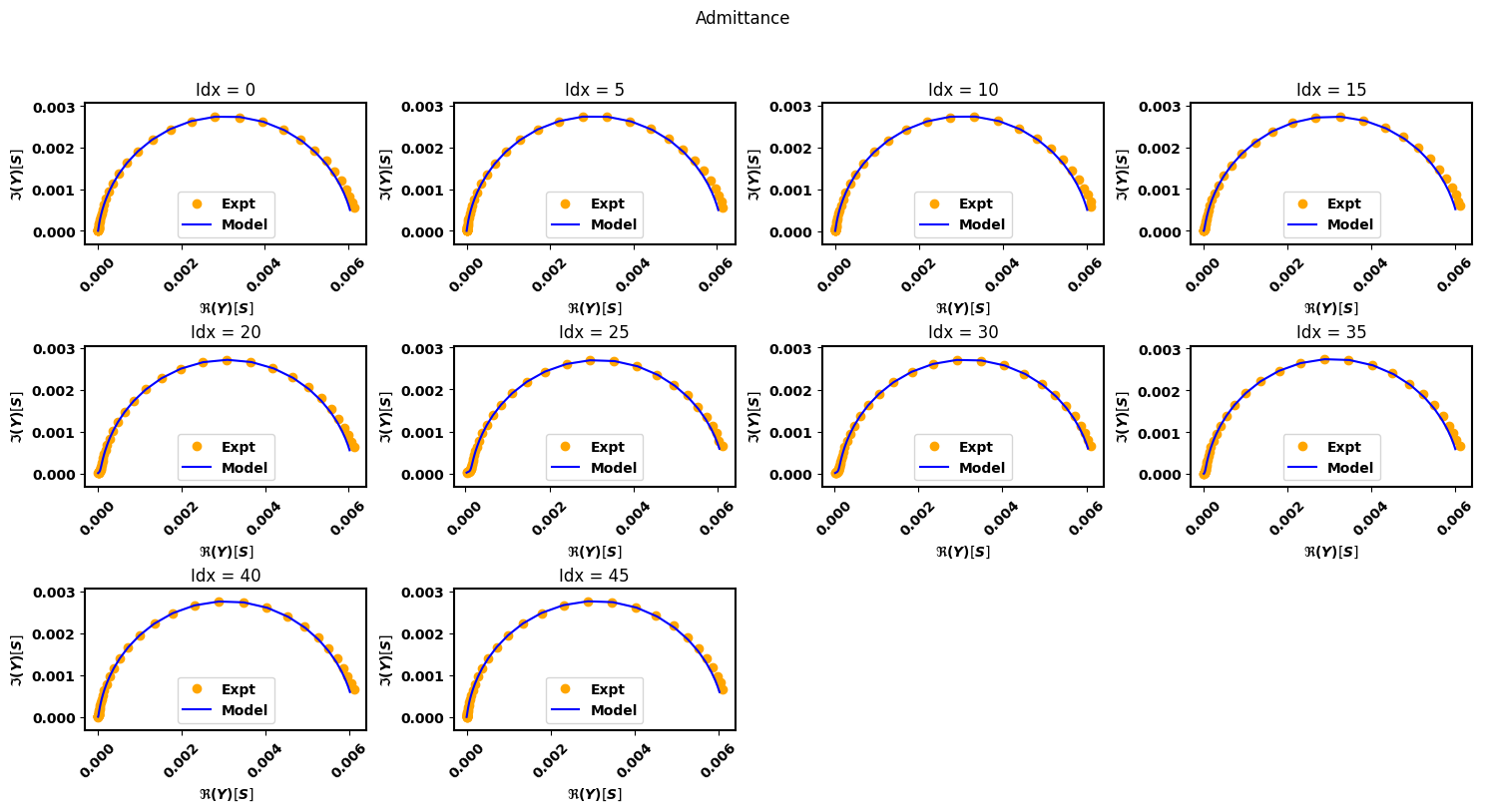
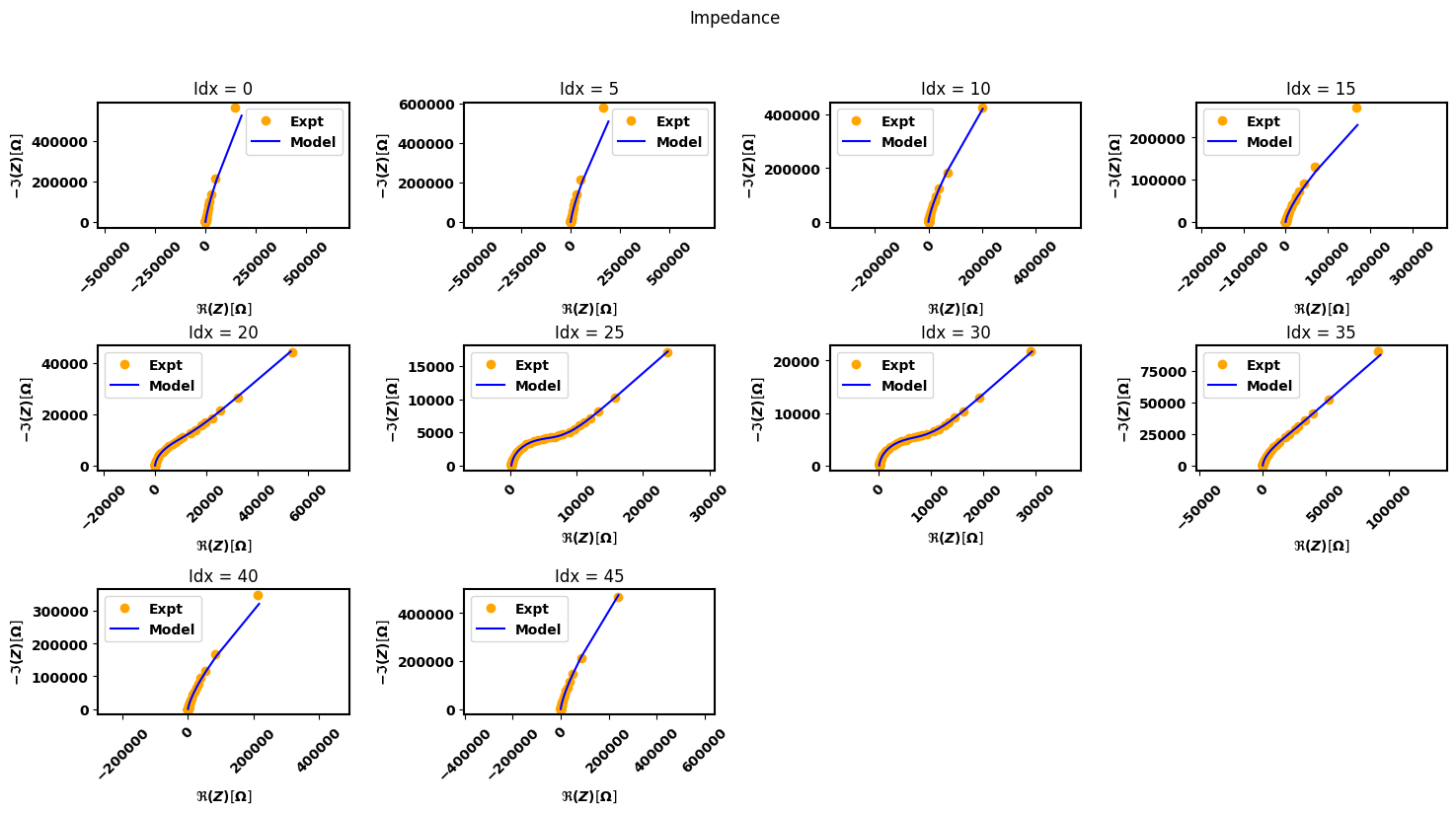
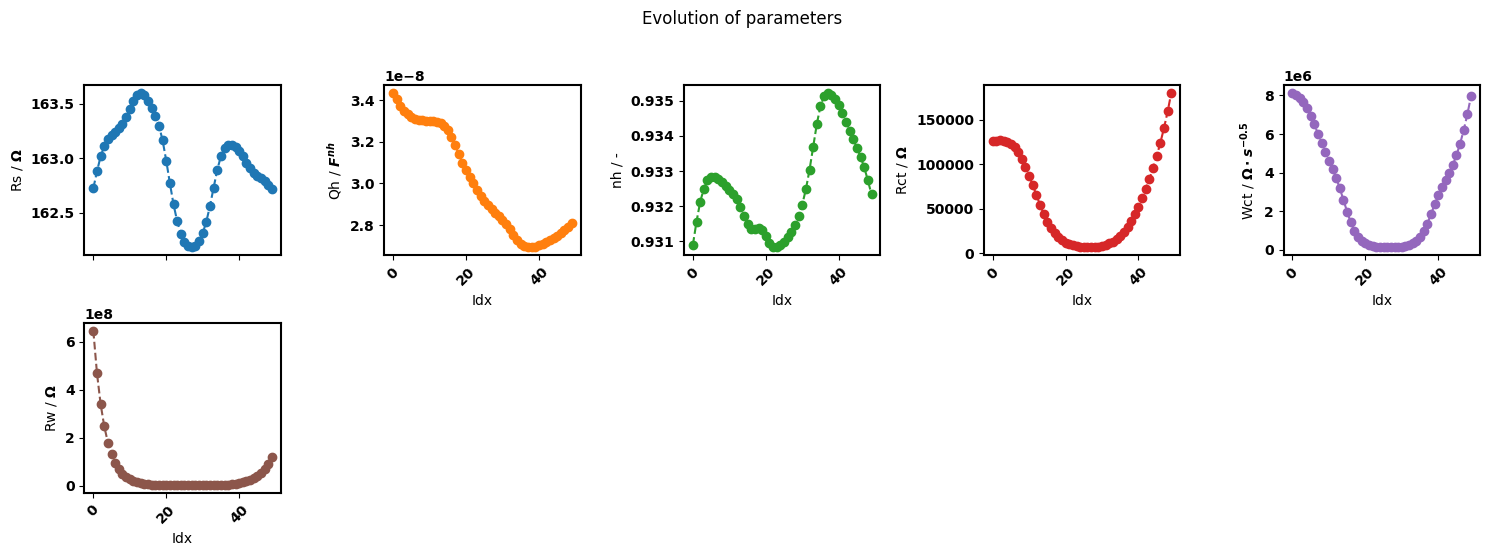
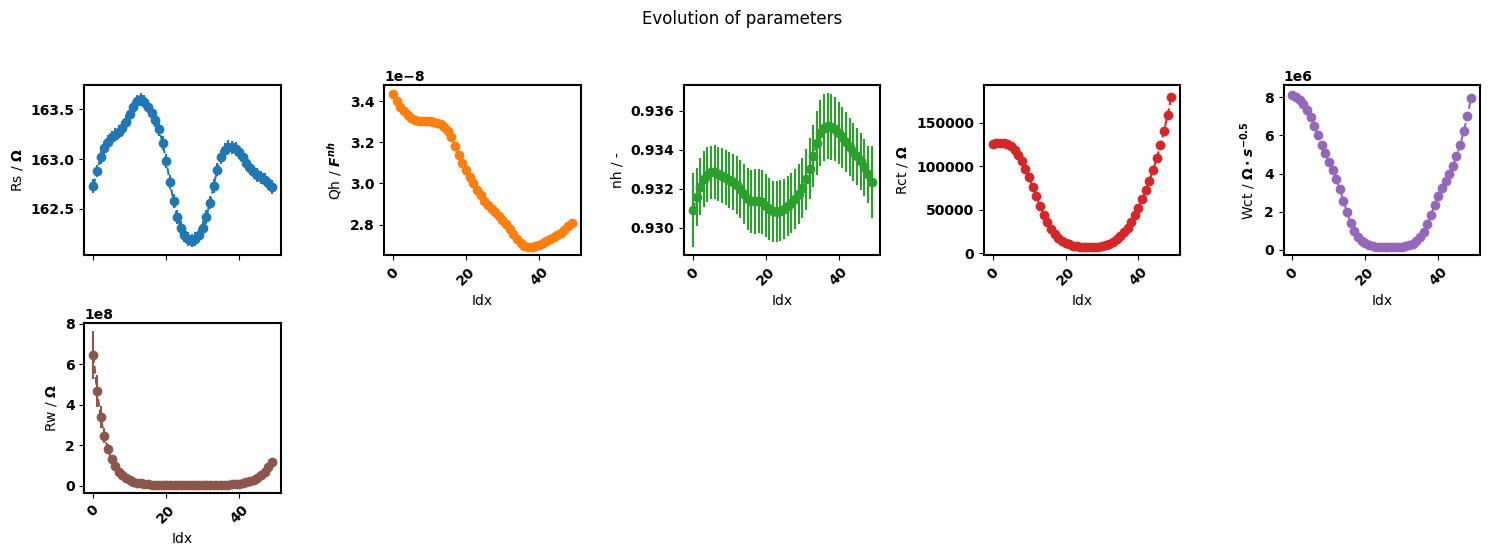
[8]:
eis_redox_sigma.cov_mat
[8]:
tensor([[ 1.8531e-07,  3.8820e-08,  1.2430e-09,  ...,  2.1912e-10,
          3.1596e-10,  4.1280e-10],
        [ 3.8820e-08,  1.3594e-07,  4.4935e-08,  ...,  1.4784e-11,
          7.7267e-11,  1.3975e-10],
        [ 1.2430e-09,  4.4935e-08,  1.4434e-07,  ..., -1.9838e-10,
         -1.7129e-10, -1.4420e-10],
        ...,
        [ 2.1939e-10,  1.3067e-11, -1.9840e-10,  ...,  1.6355e-02,
          1.7878e-02,  1.9401e-02],
        [ 3.1623e-10,  7.5436e-11, -1.7135e-10,  ...,  1.7878e-02,
          1.9614e-02,  2.1354e-02],
        [ 4.1306e-10,  1.3780e-10, -1.4429e-10,  ...,  1.9402e-02,
          2.1354e-02,  2.3321e-02]])
[9]:
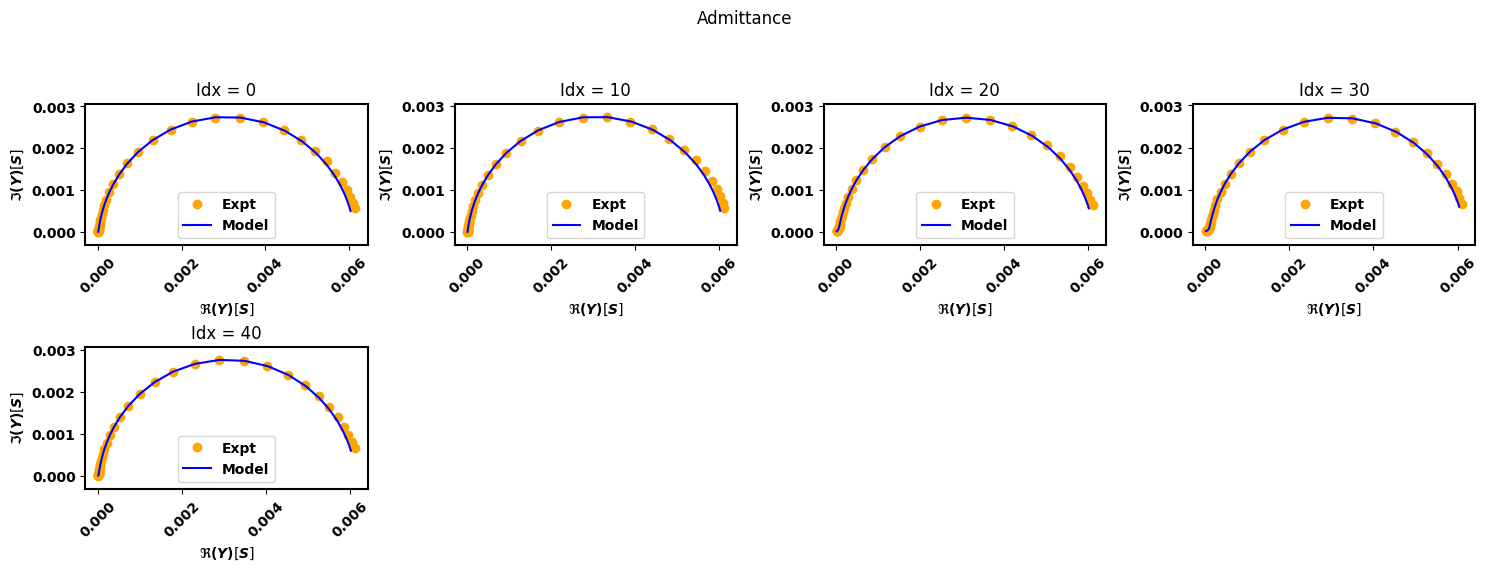
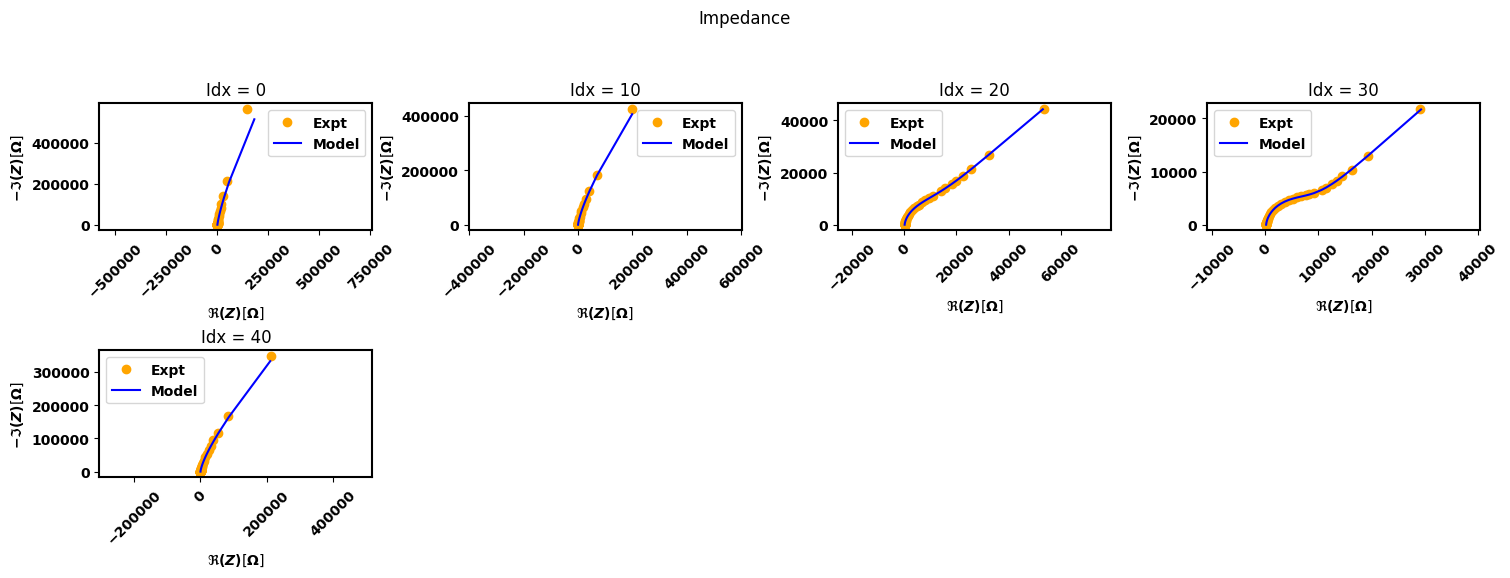
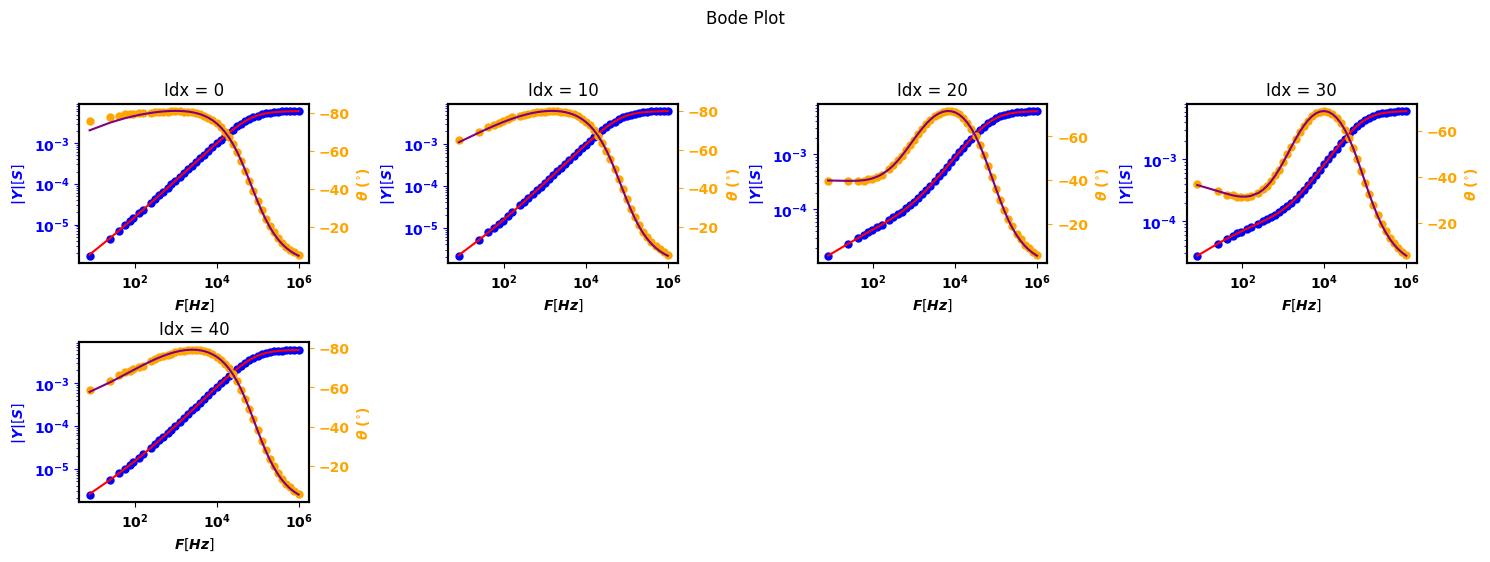
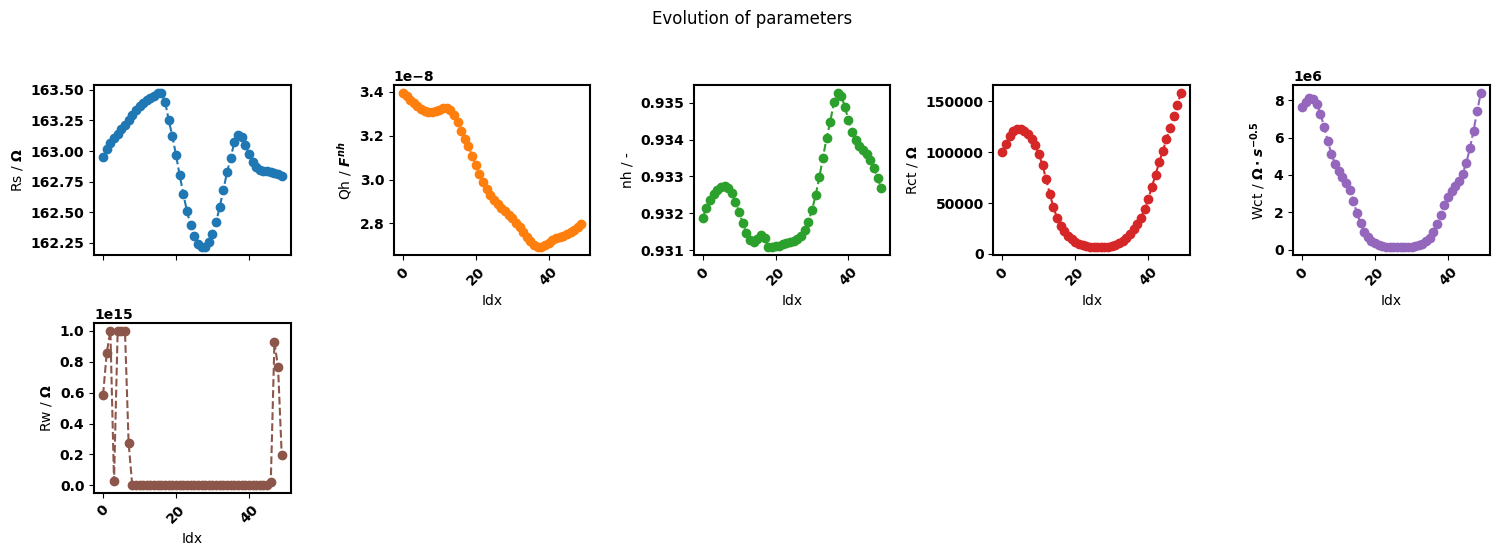
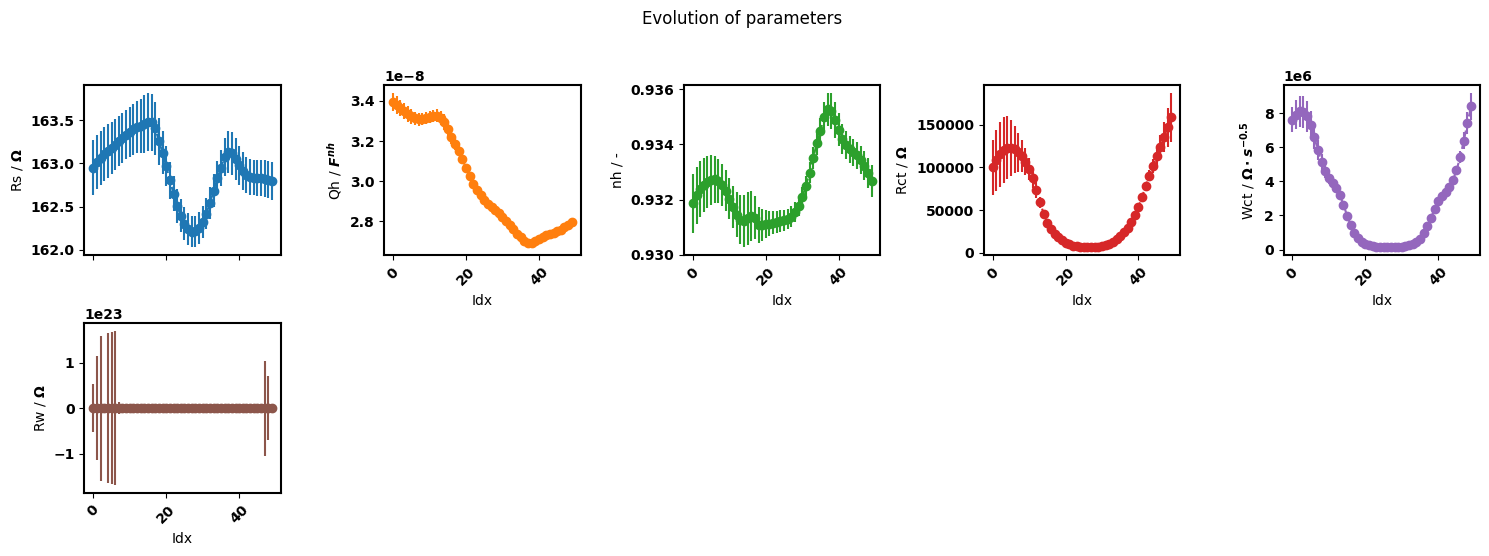
popt, perr, chisqr, chitot, AIC = eis_redox_sigma.fit_simultaneous_zero()
eis_redox_sigma.plot_nyquist(10)
eis_redox_sigma.plot_bode(steps = 10)
eis_redox_sigma.plot_params(labels=labels)
eis_redox_sigma.plot_params(True, labels=labels)
Using prefit
Iteration : 507, Loss : 2.42203e+01
Optimization complete
total time is 0:00:19.243477
2. Using the modulus as weighting
There are many cases where we do not have the data for the standard deviation of the admittance or impedance. pymultieis offers other weighting options. In this second example we shall fit using the modulus as the weighting. All you need do is set the weight parameter to the string “modulus”.
[6]:
eis_redox_modulus = pym.Multieis(p0, F, Y, bounds, smf_modulus, redox, weight= 'modulus', immittance='admittance')
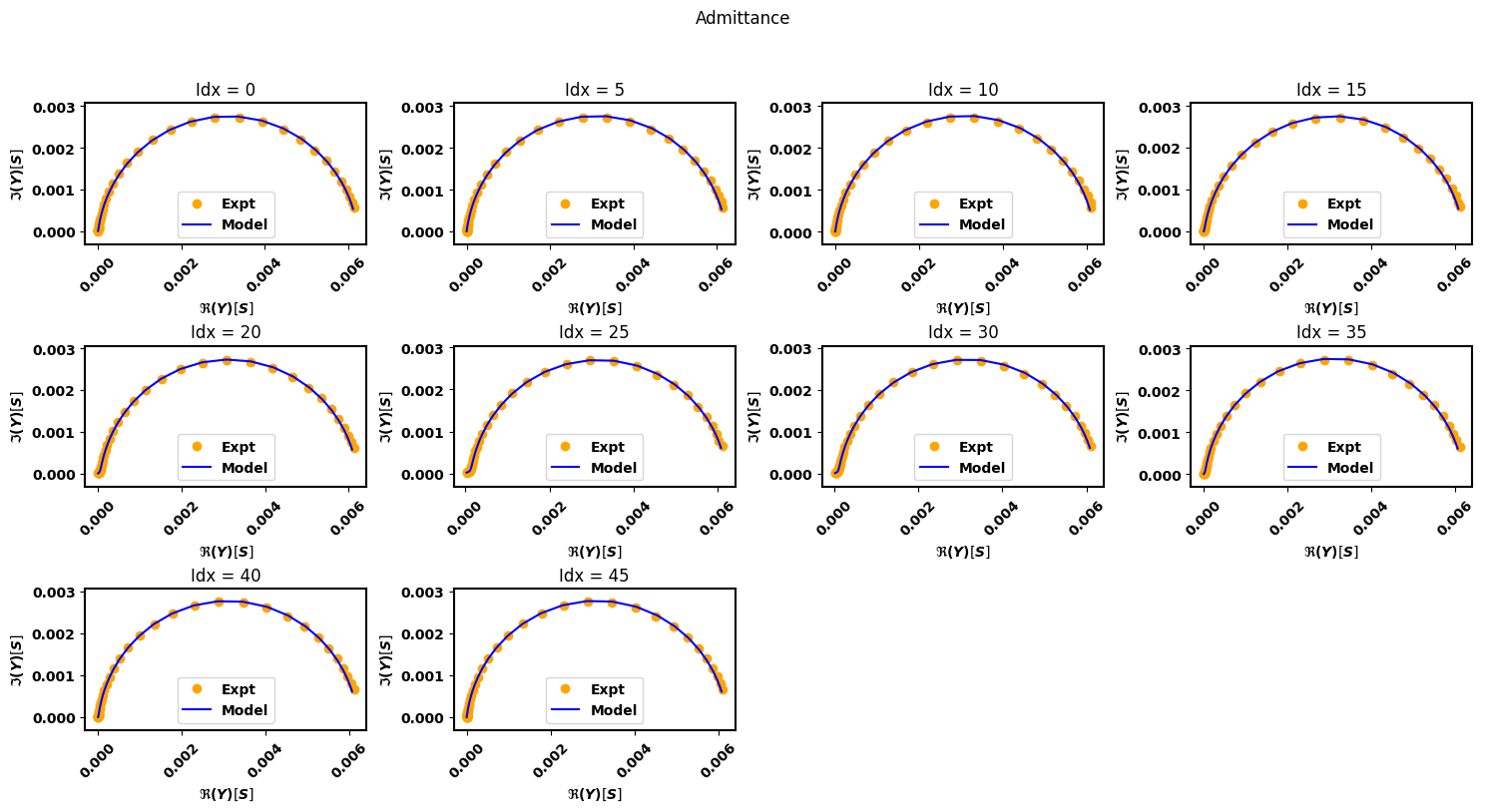
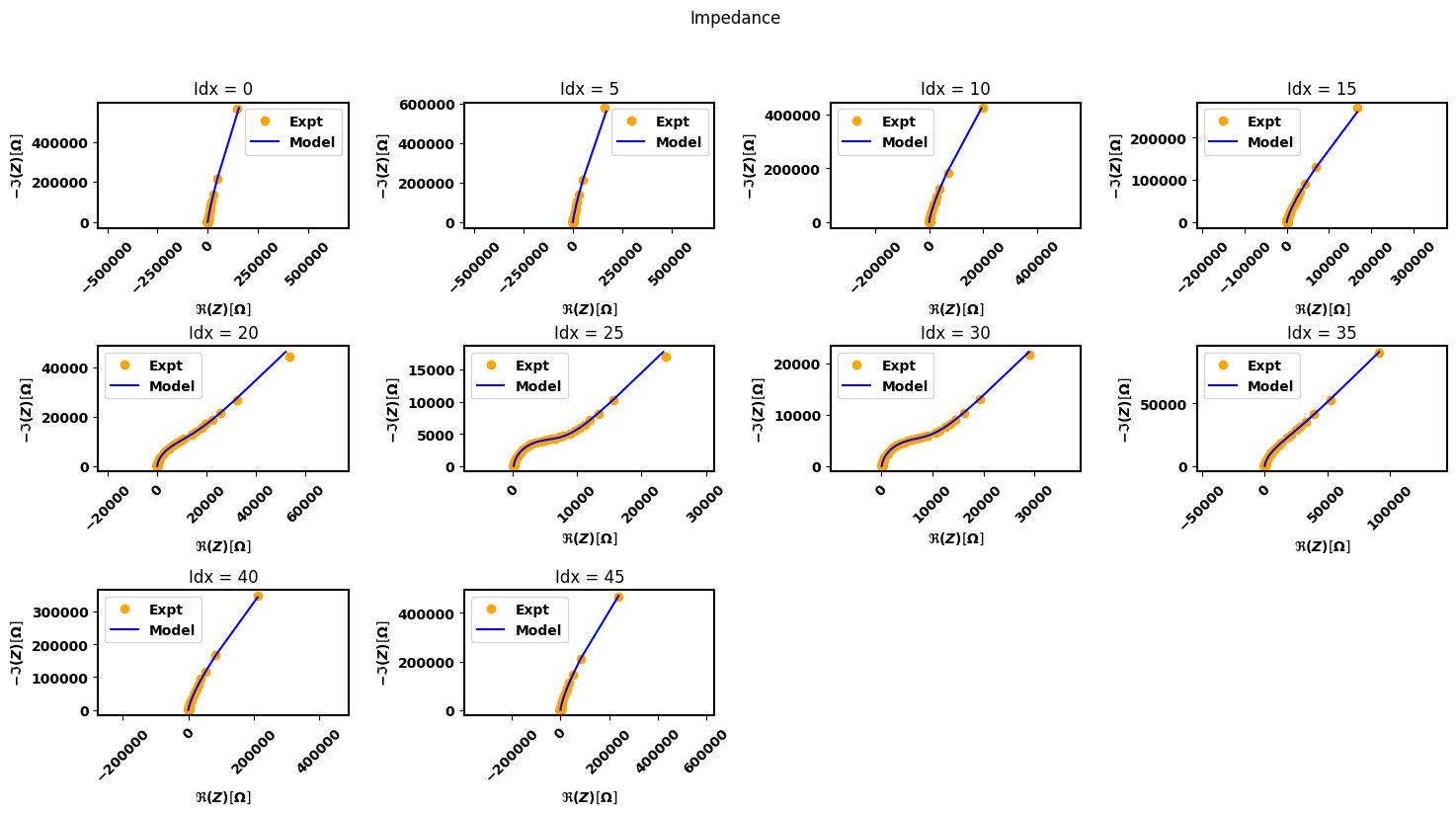
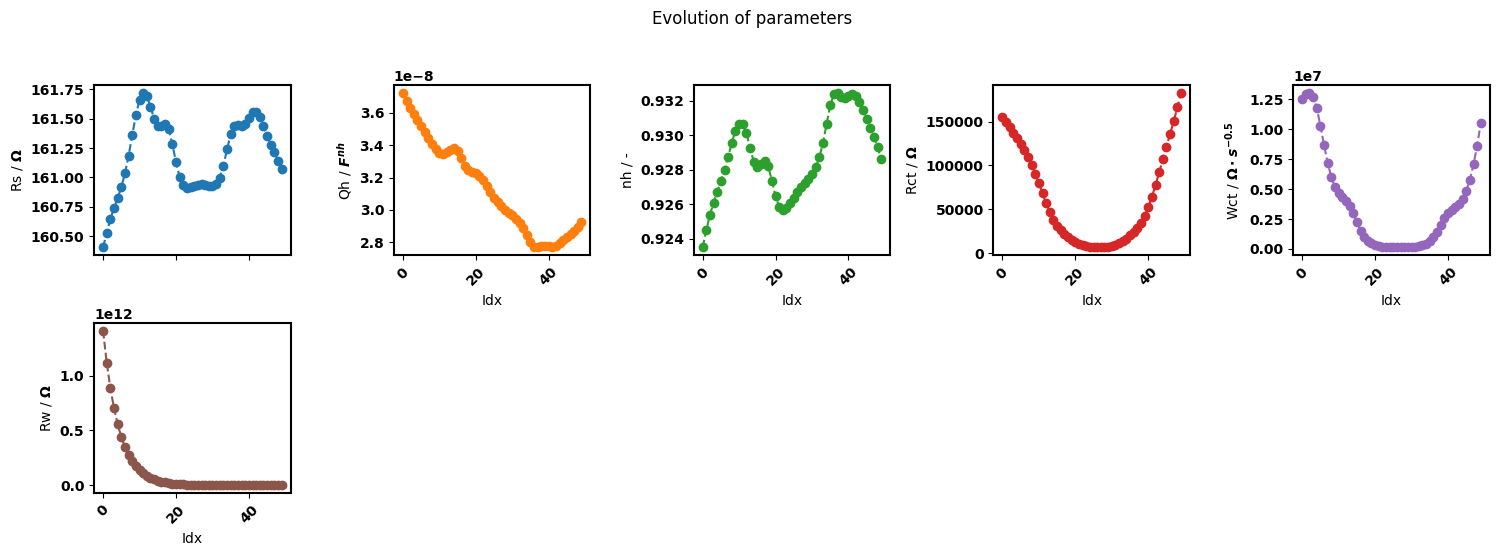
popt, perr, chisqr, chitot, AIC = eis_redox_modulus.fit_simultaneous(method = 'bfgs')
eis_redox_modulus.plot_nyquist(5)
eis_redox_modulus.plot_params(labels=labels)
eis_redox_modulus.plot_params(True, labels=labels)
Using initial
Iteration : 0, Loss : 4.11945e-01
Iteration : 767, Loss : 3.74253e-05
Optimization complete
total time is 0:00:45.652602
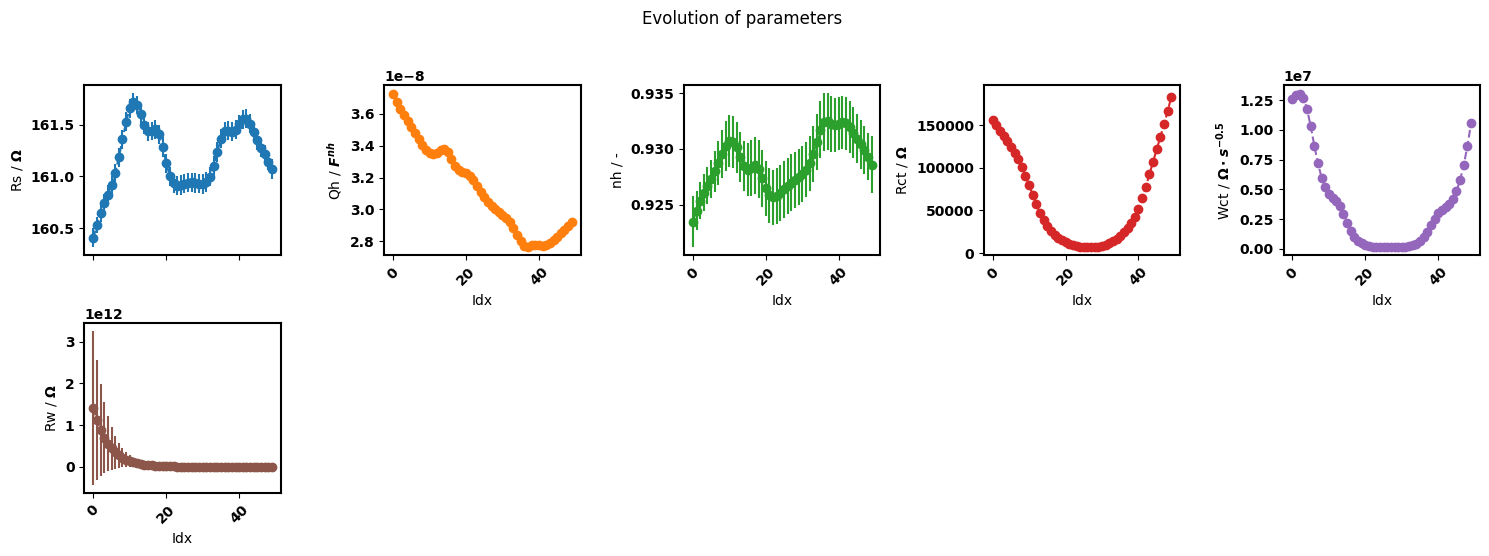
Make a least squares fit directly after running fit_simultaneous()
Here fit_sequential() uses the optimal parameters produced from fit_simultaneous() as initial guesses.
[11]:
# Reinstantiate class
eis_redox_modulus = pym.Multieis(p0, F, Y, bounds, smf_modulus, redox, weight= 'modulus', immittance='admittance')
popt, perr, chisqr, chitot, AIC = eis_redox_modulus.fit_simultaneous(method = 'bfgs')
popt, perr, chisqr, chitot, AIC = eis_redox_modulus.fit_sequential(indices=None)
eis_redox_modulus.plot_nyquist(5)
eis_redox_modulus.plot_params(show_errorbar = False, labels = labels)
eis_redox_modulus.plot_params(show_errorbar = True, labels = labels)
Using initial
Iteration : 0, Loss : 4.11945e-01
Iteration : 767, Loss : 3.74253e-05
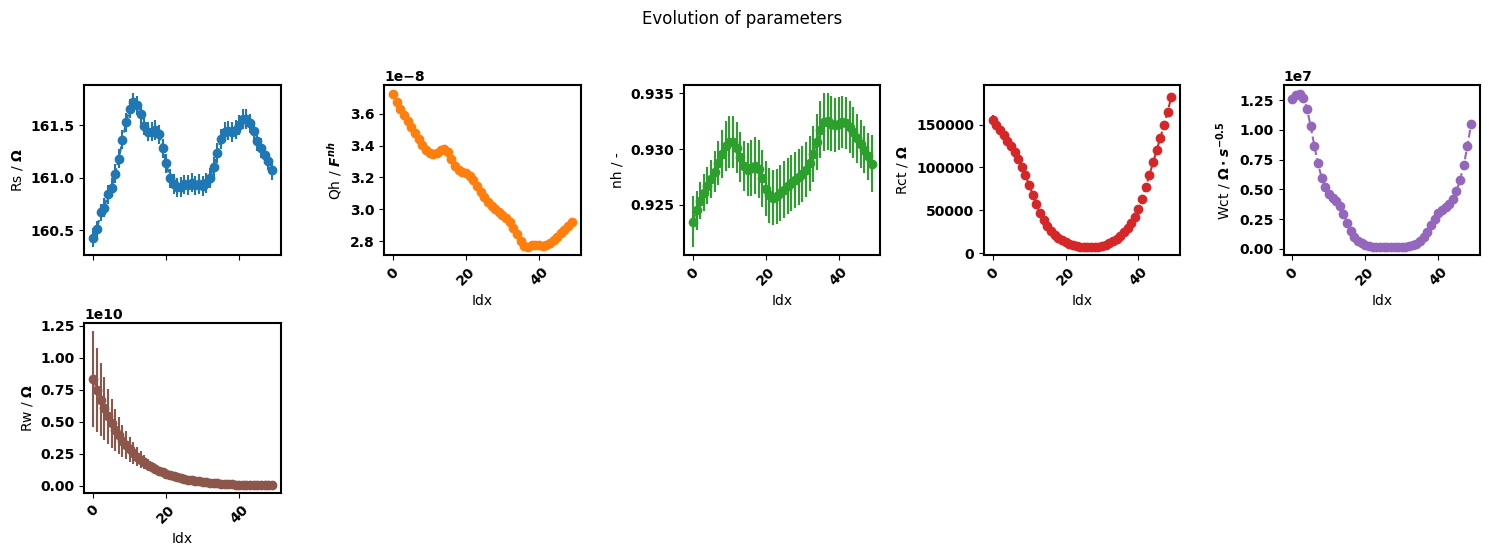
3. Fitting with the stochastic option
[ ]:
# Reinstantiate class and fit stochastic
eis_redox_modulus = pym.Multieis(p0, F, Y, bounds, smf_modulus, redox, weight= 'modulus', immittance='admittance')
popt, perr, chisqr, chitot, AIC = eis_redox_modulus.fit_stochastic()
eis_redox_modulus.plot_nyquist(10)
eis_redox_modulus.plot_params(show_errorbar = False, labels = labels)
eis_redox_modulus.plot_params(show_errorbar = True, labels = labels)
Using initial
0: loss=4.119e-01
10000: loss=4.565e-05
20000: loss=3.768e-05
30000: loss=3.754e-05
40000: loss=3.749e-05
50000: loss=3.748e-05
60000: loss=3.747e-05
70000: loss=3.747e-05
80000: loss=3.746e-05
90000: loss=3.746e-05
Optimization complete
total time is 0:05:50.534917
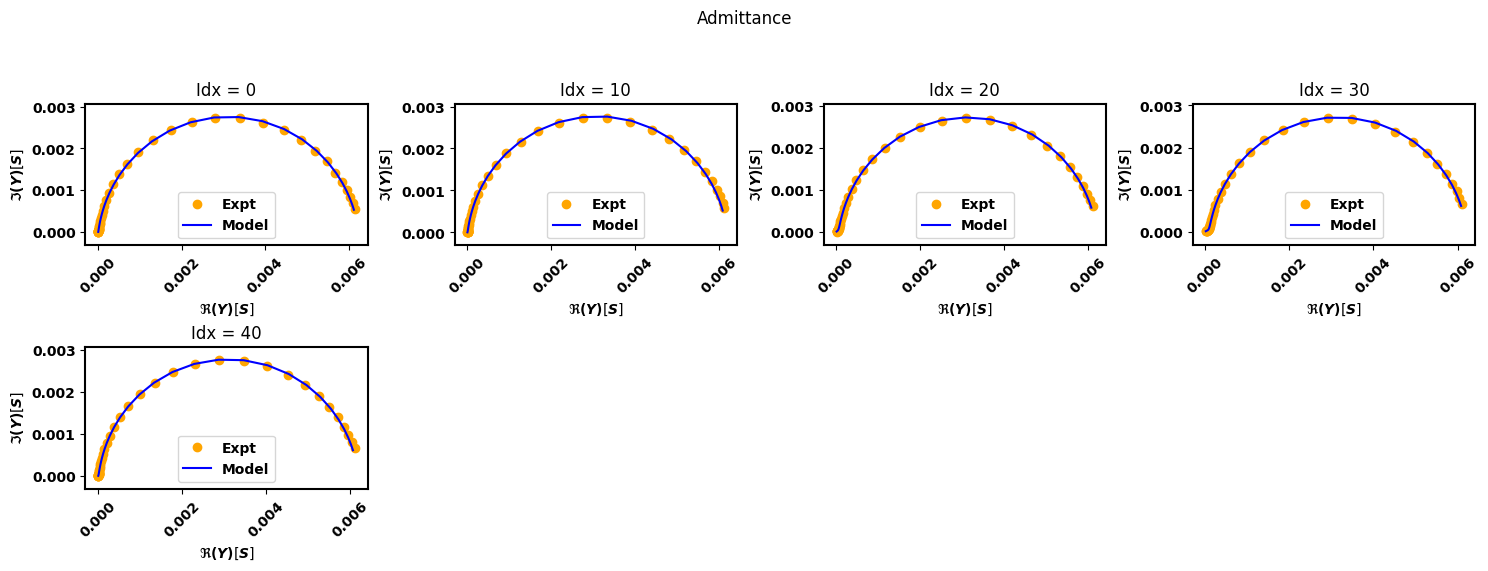
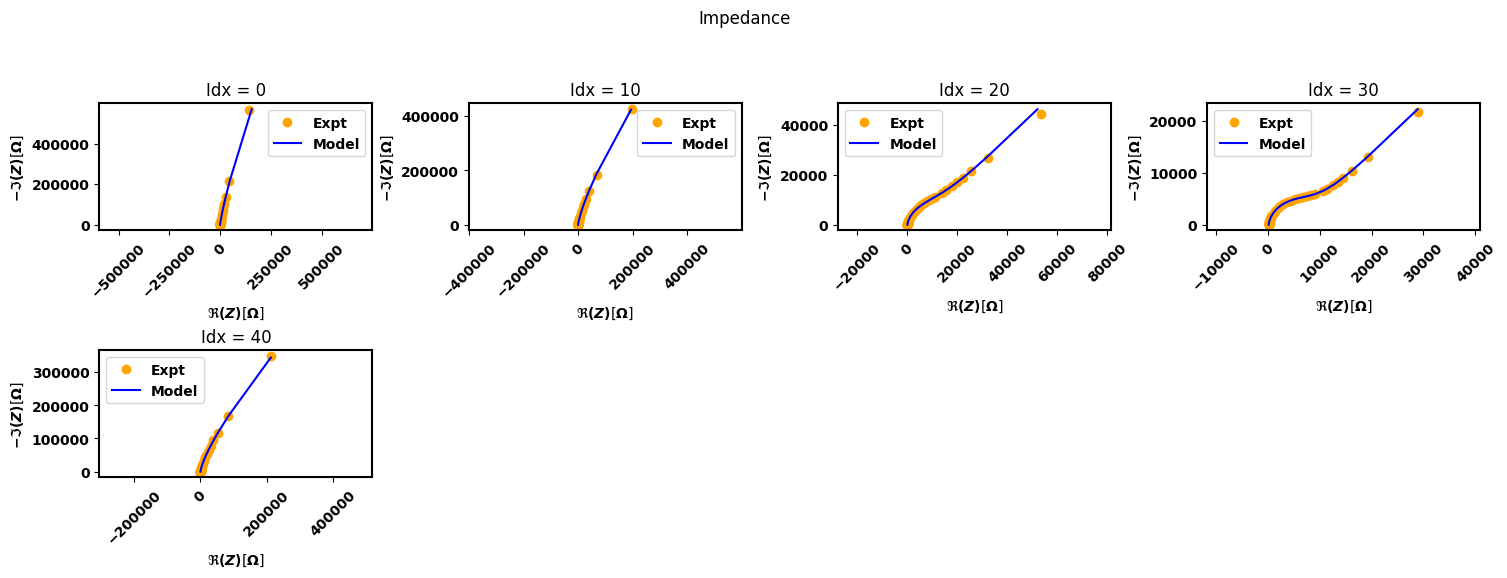
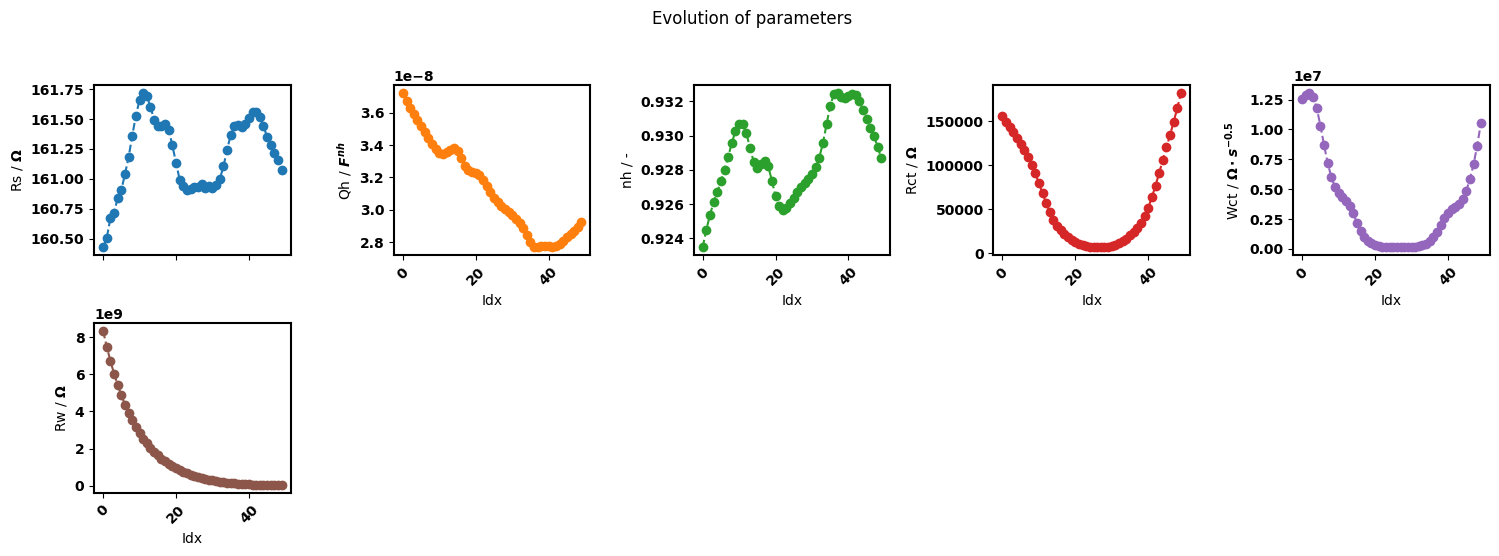
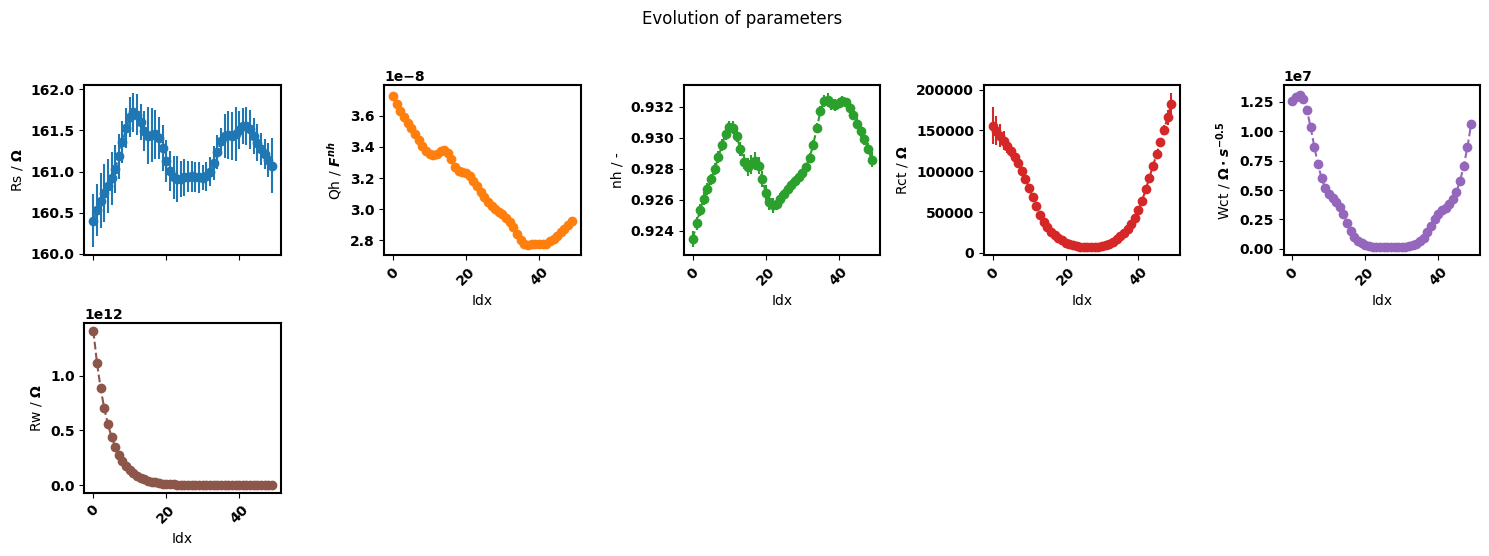
4. Running the Bootstrap MonteCarlo option
[ ]:
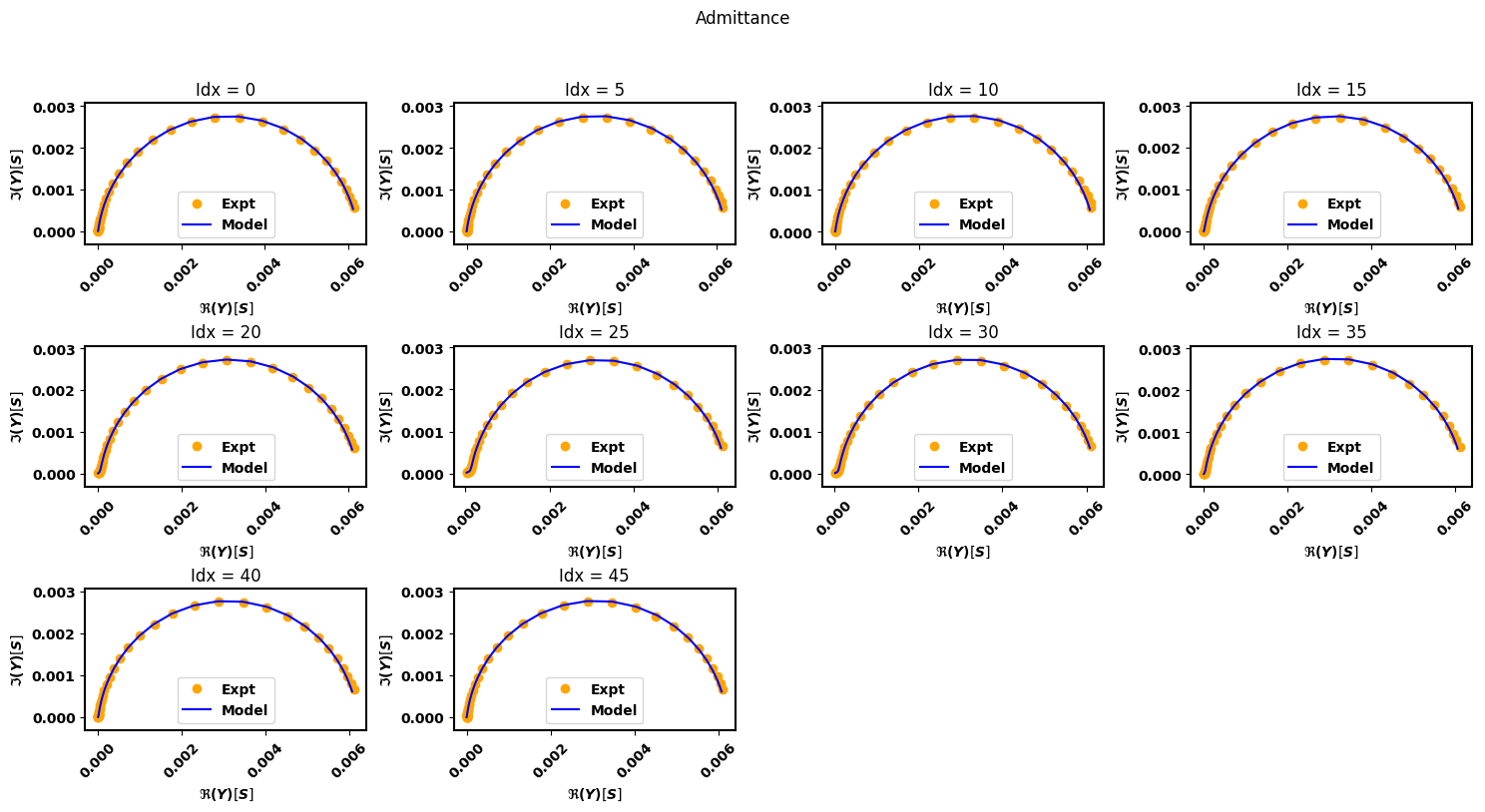
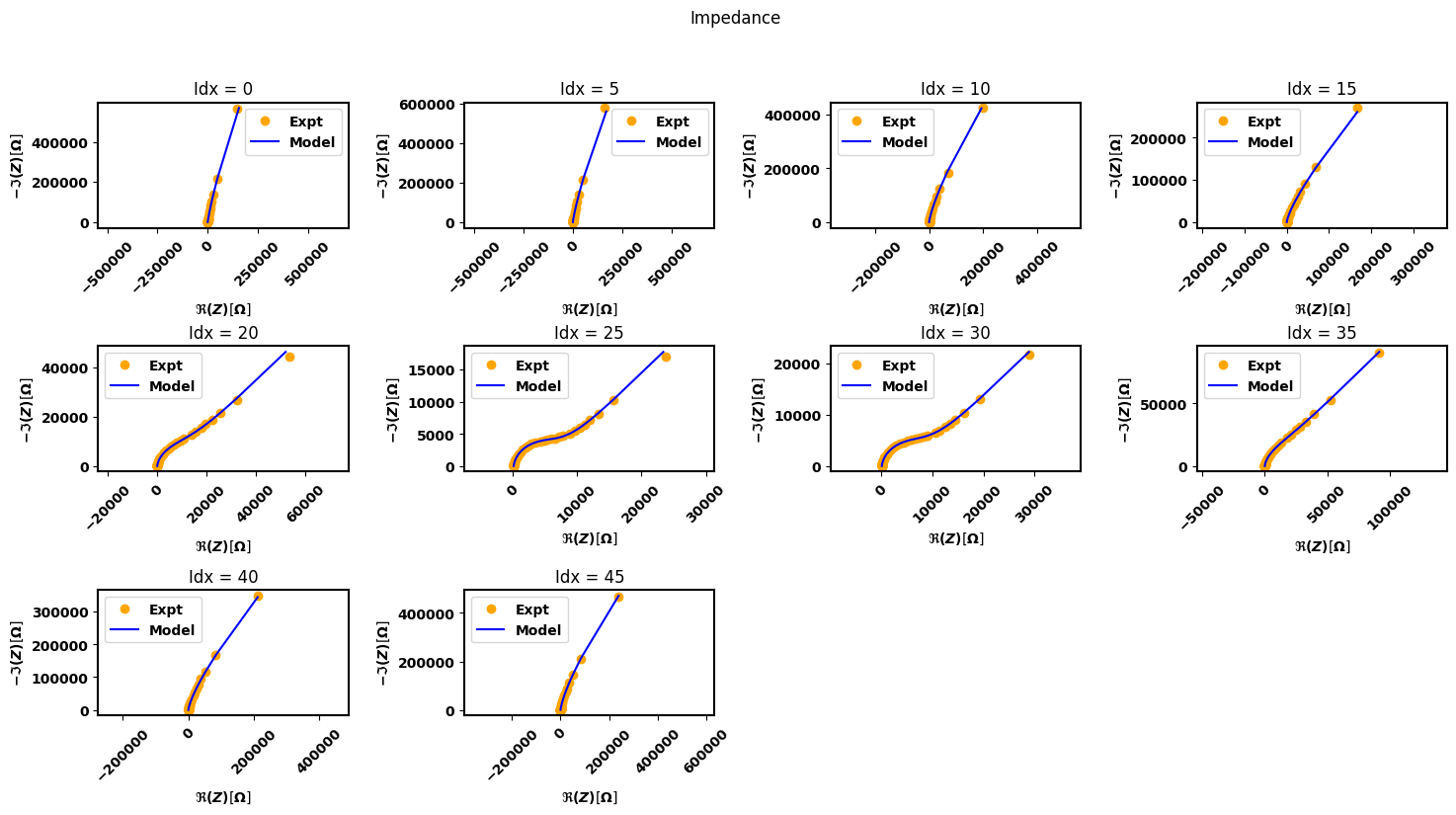
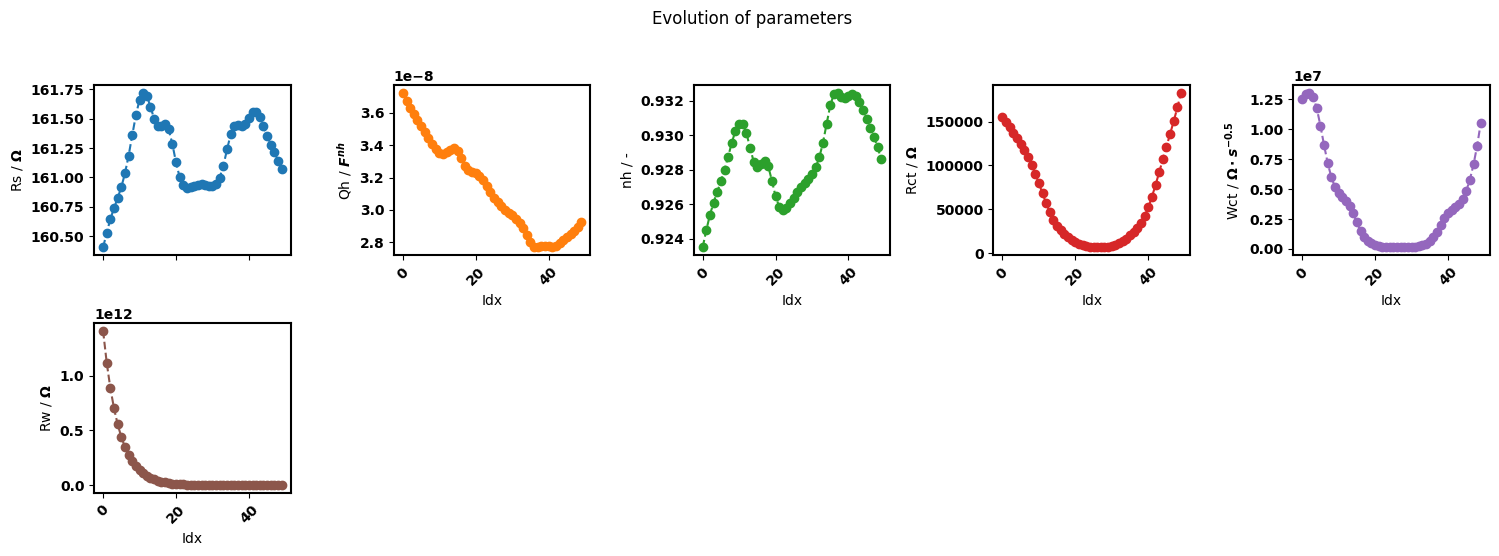
# Reinstantiate class and fit stochastic
eis_redox_modulus = pym.Multieis(p0, F, Y, bounds, smf_modulus, redox, weight= 'modulus', immittance='admittance')
popt, perr, chisqr, chitot, AIC = eis_redox_modulus.fit_simultaneous(method = 'bfgs')
popt, perr, chisqr, chitot, AIC = eis_redox_modulus.compute_perr_mc(n_boots=500)
eis_redox_modulus.plot_nyquist(5)
eis_redox_modulus.plot_params(show_errorbar = False, labels = labels)
eis_redox_modulus.plot_params(show_errorbar = True, labels = labels)
Using initial
Iteration : 0, Loss : 4.11945e-01
Iteration : 767, Loss : 3.74253e-05
Optimization complete
total time is 0:00:28.868639

Please run fit_simultaneous() or fit_stochastic()
              on your data before running the compute_perr_mc() method.
              ignore this message if you did.

Using prefit

Optimization complete
total time is 0:14:20.921227
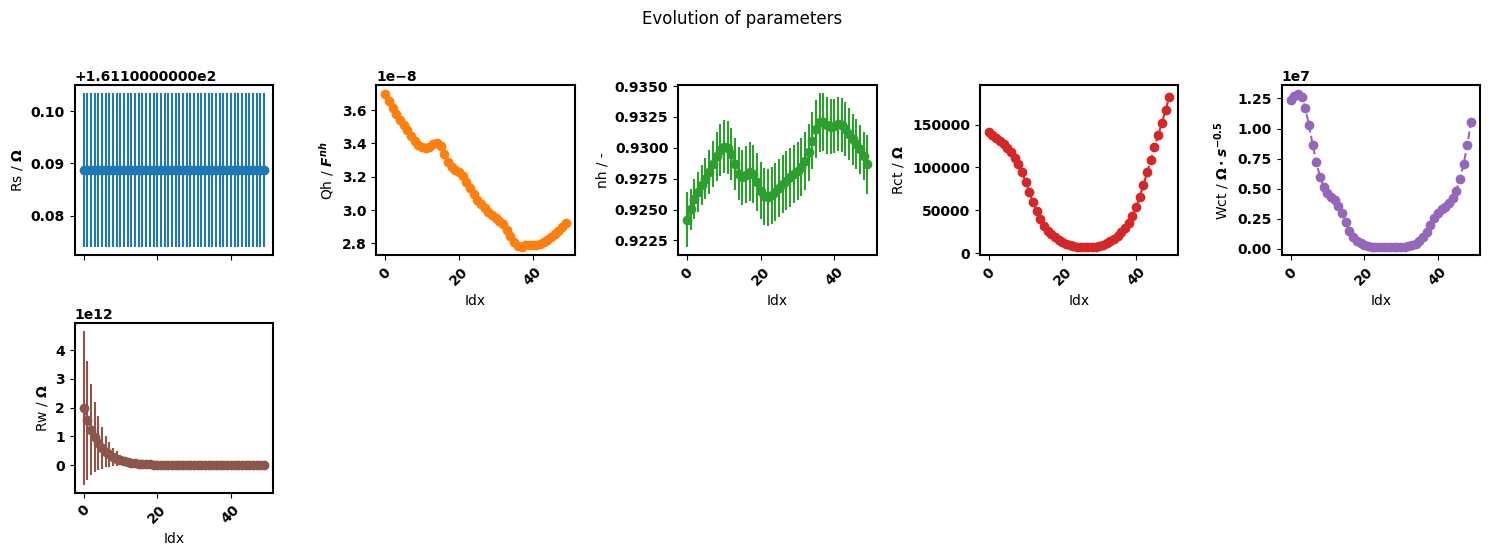
5. Keeping a parameter constant
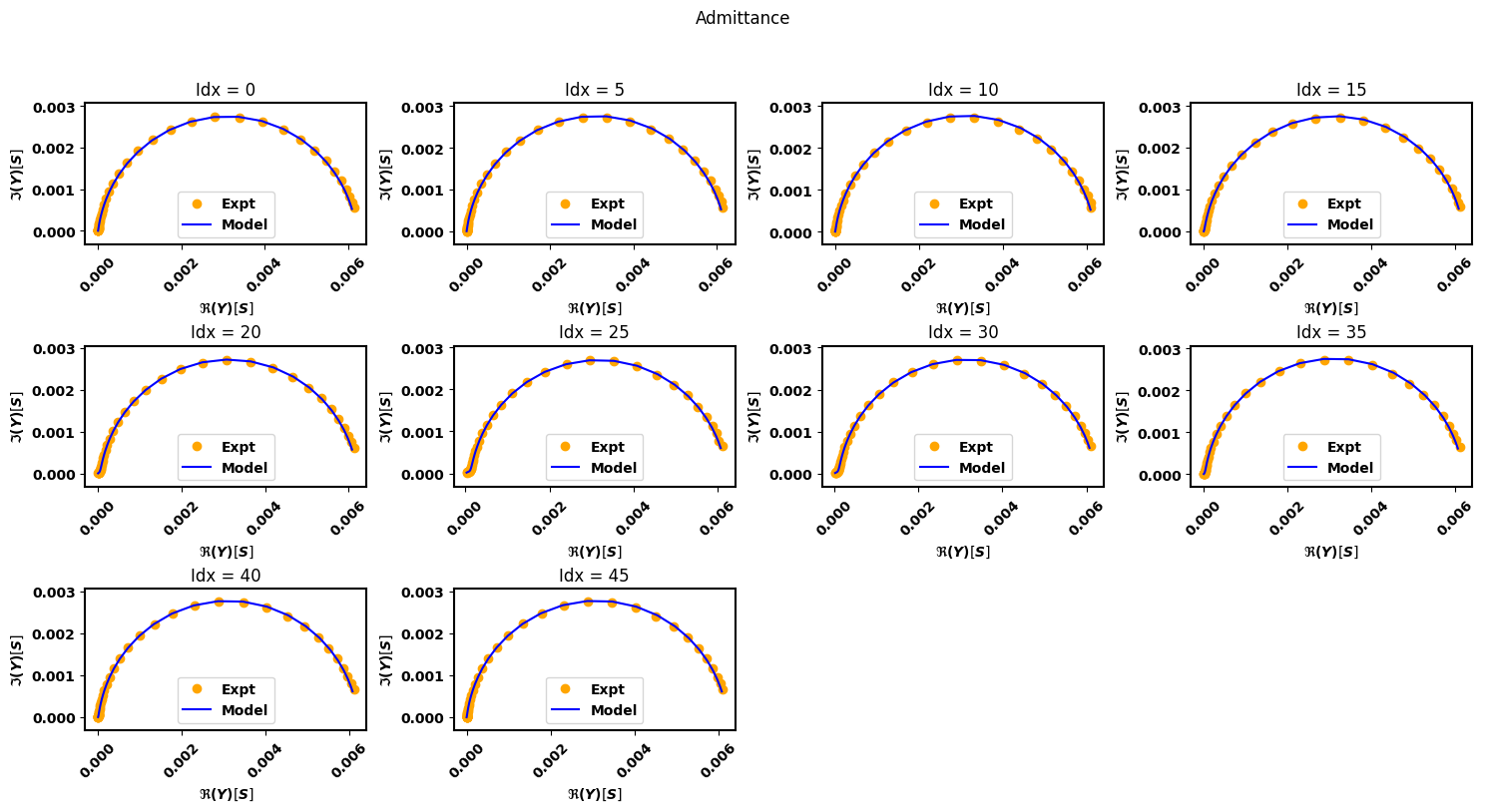
[ ]:
# Reinstantiate class and fit keeping a parameter constant
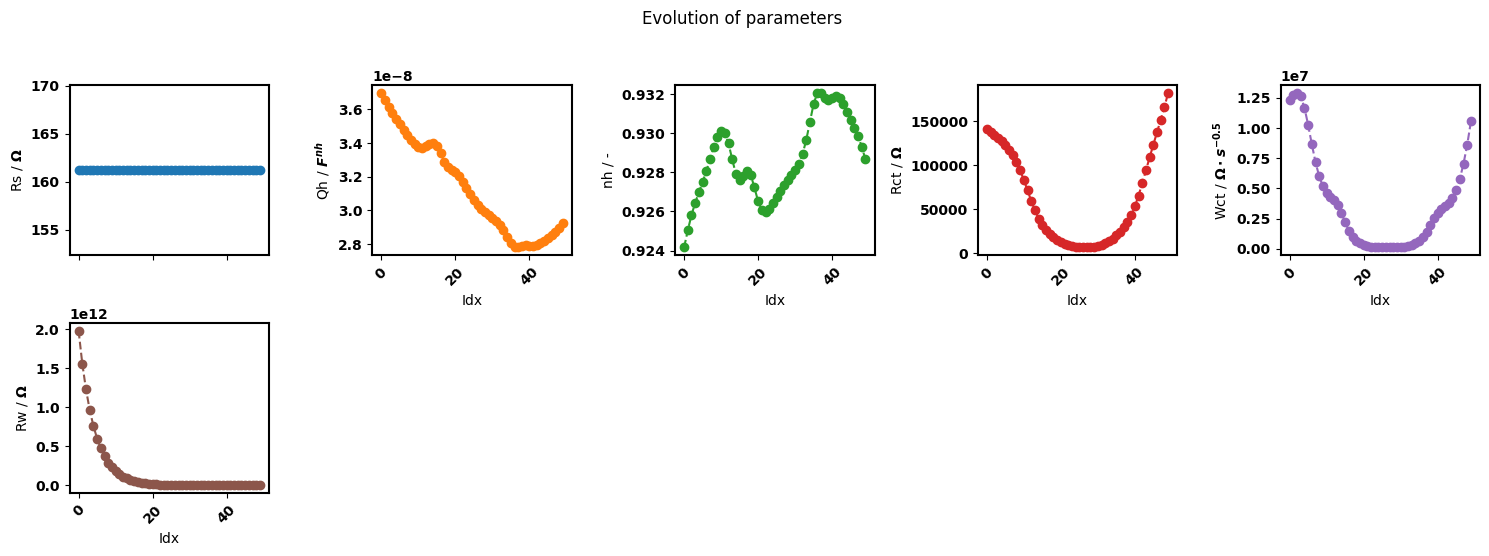
smf_const = smf_modulus.clone()
smf_const[0] = torch.inf # here we keep the first parameter constant
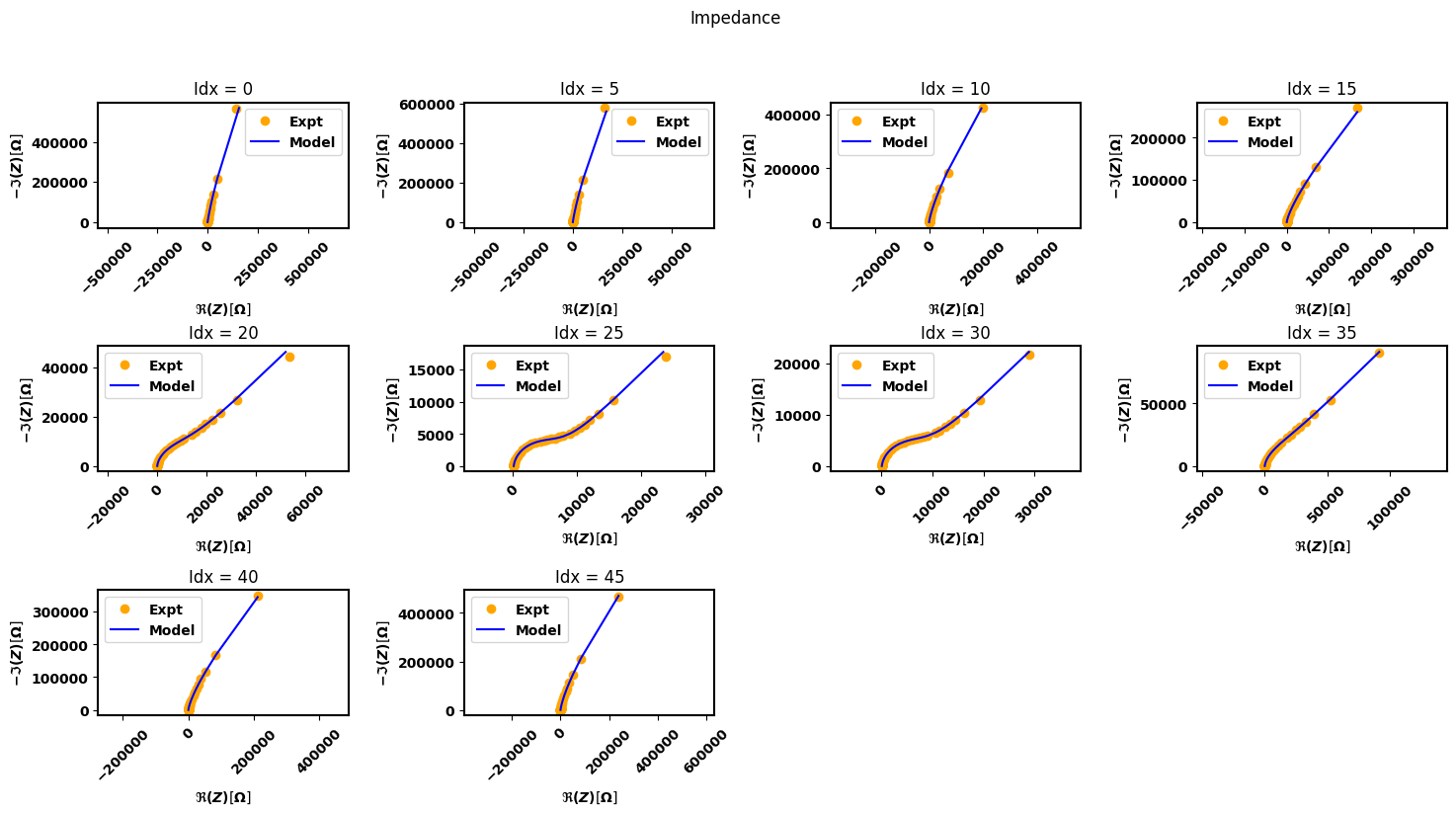
eis_redox_modulus = pym.Multieis(p0, F, Y, bounds, smf_const, redox, weight= 'modulus', immittance='admittance')
popt, perr, chisqr, chitot, AIC = eis_redox_modulus.fit_simultaneous(method = 'bfgs')
eis_redox_modulus.plot_nyquist(5)
eis_redox_modulus.plot_params(show_errorbar = False, labels = labels)
eis_redox_modulus.plot_params(show_errorbar = True, labels = labels)
Using initial
Iteration : 0, Loss : 4.11945e-01
Iteration : 667, Loss : 3.78235e-05
Optimization complete
total time is 0:00:27.158423
6. Saving the plots
[ ]:
eis_redox_modulus.save_plot_nyquist(steps=10, fname='example_results')
eis_redox_modulus.save_plot_bode(steps=10, fname='example_results')
eis_redox_modulus.save_plot_params(False, fname='example_results')
7. saving the results
[ ]:
eis_redox_modulus.save_results(fname='example_results')